Manifestation is often framed as mystical, but much of its impact can be explained by attention, belief, and behavior. The science does not prove that thoughts alone create reality, but it does show how focused intention changes what you notice and how you act.
Evidence Map (infographic)
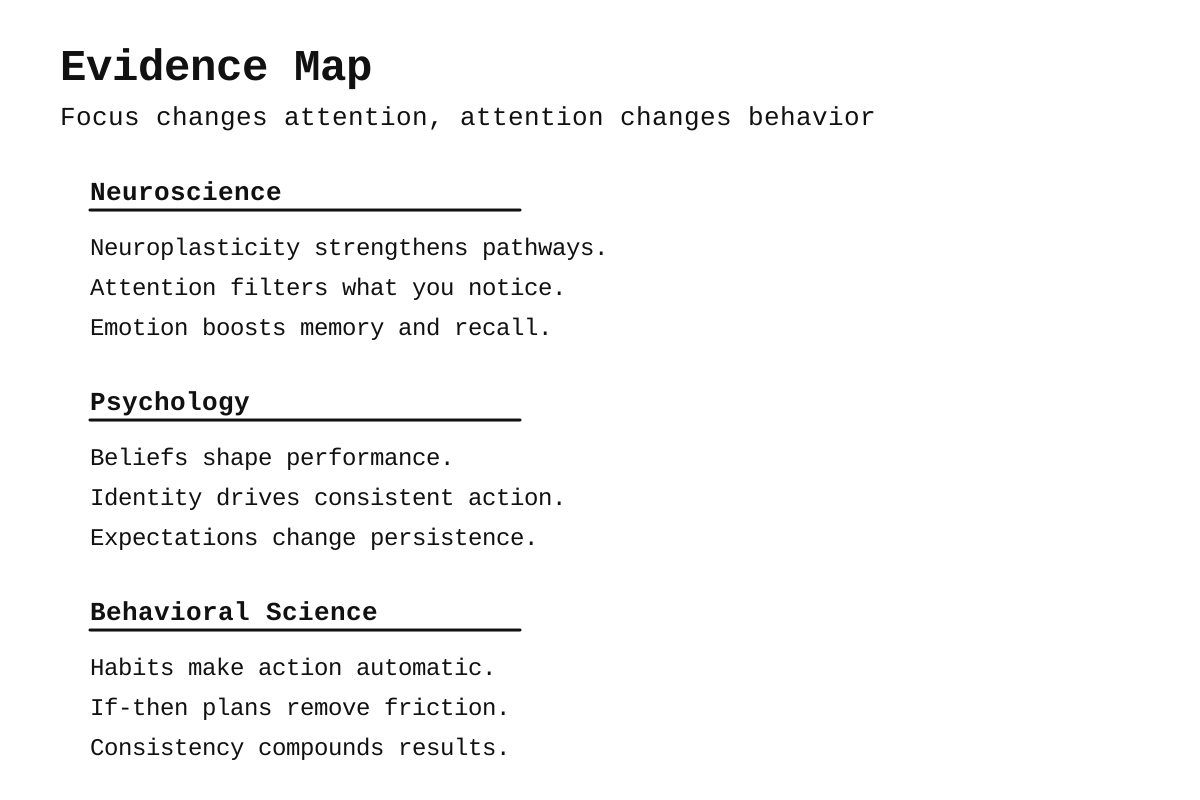
Neuroscience: The Plastic Brain
Your brain reorganizes itself based on repeated focus. This is neuroplasticity. When you consistently visualize or affirm a goal, you strengthen the neural pathways that make related actions feel more natural.
Key ideas:
- The reticular activating system filters information based on your focus.
- Repetition strengthens neural connections.
- Emotional intensity increases memory and motivation.
Psychology: Expectations Shape Behavior
The Pygmalion Effect and related research show that beliefs influence performance. When you expect a positive outcome, you take more aligned action and persist longer.
This is why:
- Affirmations work when they are believable.
- Visualization improves confidence and performance.
- Gratitude increases positive attention and resilience.
Behavioral Science: Systems Beat Wishes
Goals become real when paired with systems. Implementation intentions (“If X, then Y”) create a bridge between intention and action.
Example:
- “If it is 8 a.m., I review my vision board for 60 seconds.”
What About Quantum Physics?
Quantum physics is often mentioned in manifestation conversations. While it offers fascinating metaphors about observation and reality, it does not scientifically validate manifestation claims. Use it as inspiration, not evidence.
Integrating Science With Practice
- Focus attention on a clear vision.
- Attach emotions to make the vision memorable.
- Build daily systems that make action automatic.
- Review progress to reinforce belief.
Mindful manifestation works best as a structured practice, not a passive wish. The more consistent your attention and action, the more your environment reflects your intent.